Functions, vtrees, and circuit size
A Boolean function identifies a set of assignments. Its TDD stores that function as a circuit, sharing repeated subfunctions. A vtree groups the variables: each internal vtree node divides them into a left and a right group.
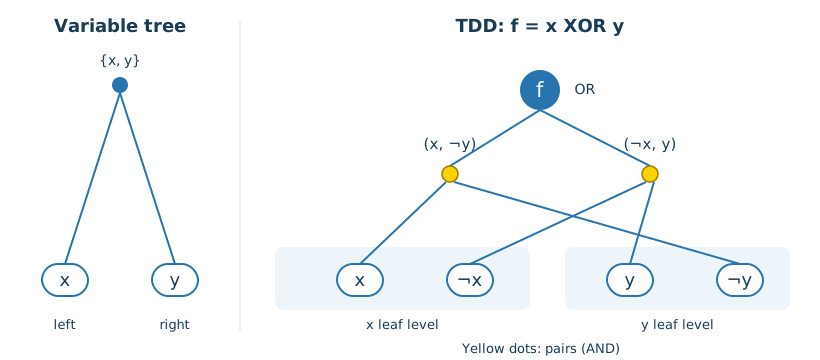
At an internal circuit node, each pair conjoins a left subfunction with a right subfunction. The node disjoins its pairs. The representation’s determinism keeps those alternatives disjoint, which permits exact counting by combining counts rather than enumerating assignments.
TDDs can be much smaller in practice than binary decision diagrams. Minimizing
a TDD makes it canonical for its vtree: equivalent functions have the same
diagram up to storage numbering. Use equivalent() to compare functions;
Python object identity and local node IDs do not establish equivalence.
The choice of variable grouping can change circuit size substantially. The
Choosing a variable grouping walkthrough compares two groupings of the same
function. node_count() and pair_count() describe stored structure;
neither is the number of satisfying assignments.
A circuit owns its nodes and retains its vtree. The vtree also provides reusable
scratch storage for operations; clear_scratch() releases idle buffers.
There is no manager object to keep alive separately. Two independently
constructed vtrees are distinct domains even when they have the same shape;
reuse one object, or obtain it from circuit.vtree, when combining circuits.
The representation and minimization algorithm are described in A Canonical Generalization of OBDD.