Note
Go to the end to download the full example code.
4. Reachability in a directed graph
Starting at node 0, which nodes of this graph can we reach?
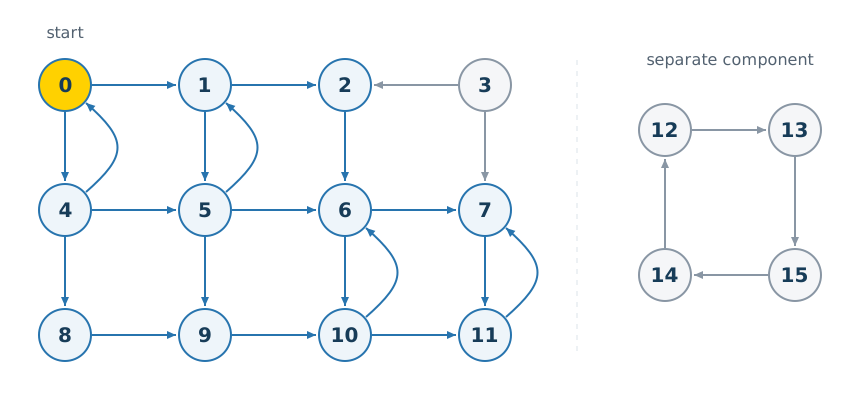
We represent a state with one Boolean indicator per node. Exactly one indicator
is true. For example,
A₀(x₀, …, x₁₅) = x₀ ∧ ¬x₁ ∧ ⋯ ∧ ¬x₁₅.
A set of states is the disjunction of their indicators.
With current-state variables x and next-state variables x′,
the transition relation is
T(x, x′) = ⋁_{(i,j)∈E} (Aᵢ(x) ∧ Aⱼ(x′)).
from tididi import Vtree, and_exists, cube, or_many

nodes = 16
edges = [
    (0, 1), (1, 2), (3, 2), (4, 5), (5, 6), (6, 7), (8, 9), (9, 10), (10, 11),
    (0, 4), (1, 5), (2, 6), (3, 7), (4, 8), (5, 9), (6, 10), (7, 11),
    (4, 0), (5, 1), (10, 6), (11, 7), (12, 13), (13, 15), (15, 14), (14, 12),
]
vtree = Vtree.balanced(2 * nodes)
current_vars = list(range(1, nodes + 1))
4.1. Build state indicators
Variable IDs begin at 1; graph nodes begin at 0. The state function asserts one indicator and negates every other indicator in the supplied group.
The second group describes the state after a transition. Each edge
contributes one conjunction to the relation; or_many combines them.
next_vars = list(range(nodes + 1, 2 * nodes + 1))
at_next = [state(vtree, next_vars, node) for node in range(nodes)]
transition = or_many(at_current[a].copy() & at_next[b].copy() for a, b in edges)
print("Transition pairs:", transition.pair_count())
Transition pairs: 176
4.2. Take one step
Conjoin the current states with the transition relation, then forget the
old state: ∃x. R(x) ∧ T(x, x′).
possible_steps = reached.copy() & transition.copy()
successors = possible_steps.exists(current_vars)
The result describes next-state variables. Rename those back to current-state variables so it can be used as the input to another step.
next_to_current = dict(zip(next_vars, current_vars))
successors = successors.rename(next_to_current)
print("States after one step:", successors.projected_model_count(current_vars))
States after one step: 2
and_exists performs the conjunction and quantification we just wrote
as two separate operations in a single call. It computes the same function
and can avoid building parts of the intermediate conjunction.
def image(states, relation):
    return and_exists(states, relation, current_vars).rename(next_to_current)


combined = image(reached.copy(), transition.copy())
print("Combined operation agrees:", combined.equivalent(successors))
Combined operation agrees: True
4.3. Iterate to a fixed point
Keep the states already reached and add their successors. Semantic equivalence tells us when this adds no new states. We count projections onto current-state variables, since the next-state variables are free here.
iteration = 0
while True:
    successors = image(reached.copy(), transition.copy())
    enlarged = reached.copy() | successors
    iteration += 1
    count = enlarged.projected_model_count(current_vars)
    print(f"Iteration {iteration}: {count} states, "
          f"{enlarged.node_count()} circuit nodes, {enlarged.pair_count()} pairs")
    fixed = enlarged.equivalent(reached)
    reached = enlarged
    if fixed:
        print("Fixed point reached")
        break
Iteration 1: 3 states, 35 circuit nodes, 37 pairs
Iteration 2: 6 states, 40 circuit nodes, 45 pairs
Iteration 3: 8 states, 41 circuit nodes, 48 pairs
Iteration 4: 10 states, 42 circuit nodes, 51 pairs
Iteration 5: 11 states, 42 circuit nodes, 52 pairs
Iteration 6: 11 states, 42 circuit nodes, 52 pairs
Fixed point reached
4.4. Two reasons for being unreachable
Node 3 is connected to the grid, but its edges point away from it and there is no path from 0 to 3. Nodes 12–15 form an entirely separate component.
print("Node 3 unreachable:", reached.implies(~at_current[3].copy()))
separate_component = or_many(node.copy() for node in at_current[12:])
print("Nodes 12–15 unreachable:", reached.implies(~separate_component))
target = reached & at_current[11].copy()
witness = target.satisfying_assignment()
active = [node for node, var in enumerate(current_vars)
          if any(choice.variable == var and choice.sign for choice in witness)]
print("Reachable target:", active)
Node 3 unreachable: True
Nodes 12–15 unreachable: True
Reachable target: [11]